ConServ Epoxy LLC, wood epoxy repair materials for preservation and restoration®
F   A   Q   s

HOME  •  Order Online  •  Prices  •  Products  •  Videos  •  Forum  •  About Us  •  FAQ  •  Tips  •  Gallery  •  Contact
Frequently Asked Questions
  1. Q:  Why should I use epoxy to repair deteriorated wood?
  2. Q:  What’s the difference between consolidation and patch/filling?
  3. Q:  Do I have to remove all of the rotted wood from the affected area?
  4. Q:  How dry should the wood be before attempting epoxy repairs?
  5. Q:  What’s the difference between a cosmetic repair and a structural repair?
  6. Q:  How do I determine how much epoxy I will need to make my repairs?
  7. Q:  Must I wait for the consolidant to cure fully before applying epoxy patch on top?
  8. Q:  Can the epoxy products be mixed in smaller quantities than those in which they’re sold?
  9. Q:  Can epoxy repairs be painted or stained to match surrounding areas?
  10. Q:  Where can I get ConServ products?


  1. Q:  Why should I use epoxy to repair deteriorated wood?

    A:  Over the years, folks have commonly used materials like mortar, concrete, wood putty, caulk and the like to fill and repair rotted portions of wood on houses, cabins, trim and furniture.  Although these repairs apparently solved the current problems they all presented additional difficulties sometime in the not too distant future.  Each of them contained some form of vehicle to transport the filler material such as water in the case of mortar or concrete and solvents in the wood fillers and caulks.  These solubles are prone to evaporation and thus shrinkage as the materials age.  As the shrinkage occurs, adhesion is lost between the patch and the adjacent wood creating a crack or void which can trap moisture, harbor infestation, promote deterioration and eventually lead to the failure of the repair as the filler falls out.

    ConServ Epoxies are made from a "flexible" formulation of virgin epoxy resins with no solvents to off gas or evaporate.  This makes for a very stable "non-shrinkable" patch filler, which is capable of flexing and adapting to daily and seasonal temperature changes over its entire life.  Most ConServ patches are pliable enough to place a thumbnail print in.  This consistency most closely imitates the density and properties of real wood, allowing the user to modify and trim the patch with conventional carpentry tools.  Almost twenty years of successful field application gives ConServ Epoxies the kind of reputation and expertise that you can count on for your projects.

    [ Return to top of list ]

  2. Q:  What’s the difference between consolidation and patch/filling?

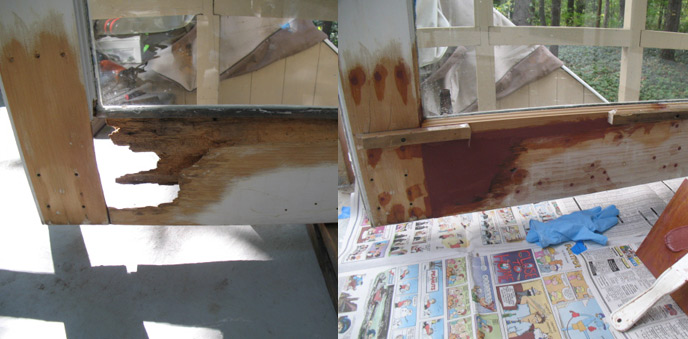
    A:  ConServ Epoxy 100 Consolidant is a water thin, crystal clear, flexible two-part epoxy used to impregnate or saturate the decayed area of wood.  The introduction of the flexible epoxy deep into the affected area will serve to consolidate or "petrify" the rotted wood fibers into a durable surface unaffected by the ravages of weather, bugs and abuse.  On some repairs with minor surface damage consolidation will suffice to prepare the wood for primer and paint.  On repairs requiring larger patches to fill voids and cracks or to replicate damaged shapes, the consolidant 100 must be used as a primer to create a "tough and toothy" base for the 200 patch/filler to adhere to.  These void filling repairs call for a flexible epoxy filler capable of sticking to the surrounding wood tenaciously while filling and keeping the desired shape.  Once cured the ConServ Epoxy 200 Patch/Filler is easily worked to conform to shape and accept fasteners and finishes like wood.

    [ Return to top of list ]

  3. Q:  Do I have to remove all of the rotted wood from the affected area?

    A:  No, ConServ Epoxy Consolidant 100 is thin enough to penetrate deep into the wood fiber, creating a semi-solid mass capable of withstanding abuse.  We recommend removal of all materials lying loosely about the decayed area and or easily stripped away using simple means such as a scraper, wire brush or the like.  It is not necessary to get down to bare new wood in order to ensure the success of the patch.  Use common sense to remove what appears weak and allow the consolidant to stabilize the rest.  Your goal is to apply or introduce as much consolidant 100 as possible to the softwood.  The deeper you are able to penetrate the better the repair will be. Subsequent applications over a period of several hours will promote greater saturation while drilling holes in and around the affected area can enhance penetration.

    [ Return to top of list ]

  4. Q:  How dry should the wood be before attempting epoxy repairs?

    A:  Some manufacturers will insist on a 20% moisture content or less before even thinking of making epoxy repairs.  Likewise you will find in our technical literature that we too adhere to this number.  We go on to say that these repairs, if made under laboratory conditions, will optimize the process of creating the best possible conditions for durability and longevity.  However, none of us lives in a laboratory and we frequently find it impossible to either accurately measure these conditions or maintain them under job site conditions.  This means you need to be sensible and exercise some judgement here.  If the materials can be removed to an indoor location you should do so and attempt there to lower the moisture content using whatever means you find available.  If not, then you should make reasonable attempts to reduce the presence of everyday moisture in the form of rain, snow , runoff, condensation or whatever for as long a period as is practical prior to scheduling your repairs.  These efforts can be enhanced using conventional means such as plastic tarps, tar paper, ventilation, fans, heaters, etc.  The point is that you should make every effort possible to reduce that moisture content to as low a level as you can.  This will ensure maximum penetration of the consolidant and reduce the risk of continued or future infestation by fungus or insects.  By using the best materials available and the best effort possible you will give your project the best chance for survival in the future.

    [ Return to top of list ]

  5. Q:  What’s the difference between a cosmetic repair and a structural repair?

    A:  Most often we refer to structural repairs as those being done to enhance or replace the load carrying ability of a load bearing element in a wood structure that has been compromised by decay.  That might mean repairing a rotted sill beam or girder under a compressive load in a house.  It could mean splicing a broken load bearing rafter or joist in mid span.  It might also mean patching a log, timber or beam at a joint or load transferring point.  These types of repairs usually incorporate ConServ Structural Epoxy Repair 600 cast in place and sometimes the introduction of fiberglass reinforcing bar into the affected joint.  Structural repairs can be accomplished by attaching new timbers or wood "Dutchman repairs" to decayed areas.

    Cosmetic repairs are most often done using ConServ Epoxy Patch/Filler 200 when only superficial loads are applied to elements such as trim, minor framing or logwork, and decorative millwork.  Although strength and durability are important, the integrity and safety of the structure are not in question for these types of repairs.  Appearance of the repair is utmost and ConServ Epoxy 200 Patch/Filler is easily applied, shaped, and finished to imitate the original wood element.  If after considering these examples, you still have some question as to the appropriate use of the materials please consult with us and we’ll be glad to help you or your engineer arrive at the proper selection.

    [ Return to top of list ]

  6. Q:  How do I determine how much epoxy I will need to make my repairs?

    A:  This is probably the most asked question and likewise the one we try to dodge most often.  What I really mean to say is that we cannot over the phone get an accurate feel for the degree of deterioration, the depth of the decayed portion or the number of affected areas comprising the repair.  We can help you to understand what the materials are capable of doing and thereby make you more able to understand the degree of repair you should be undertaking to perform a proper job.  In the case of consolidation the key word is penetration.  You need to introduce as much of the ConServ 100 into the affected area as you are physically and financially able.  Job constraints such as money, time, expertise, and so on all have to weigh on your decision to buy more or less epoxy.  Is this your house or is it a customer's?  Is this an everyday repair or a historically significant struct ure being conserved?  Only you can decide how good is good enough.  I will add that if you have made every effort to apply the consolidant in a thorough fashion, and done so in a repeated manner to the point at which it appears to not soak in any further, then you have probably accomplished your task.  Our epoxy has a one-year shelf life guarantee and it can last significantly longer if properly kept.  This means that you can always use later what seems left over now.  Plan ahead to do the job right and deal with any leftovers later!

    The ConServ 200 patch/filler is more easily quantified.  Since it contains no solvents or evaporating agents it will not shrink and it does not expand, therefore it is a one to one relationship.  A one-gallon can fills a one-gallon void.  You should roughly estimate the voids by volume and then think about introducing some dry "filler" wood into any of the very large repair areas.  These areas needn’t be filled entirely with epoxy.  Small sections of dry wood should be "buttered" into place allowing sufficient epoxy at the surface to facilitate shaping and finishing.  Large voids may need two applications to prevent excessive heat buildup during the curing process but general several inches can be applied at a time safely.

    [ Return to top of list ]

  7. Q:  Must I wait for the consolidant to cure fully before applying epoxy patch on top?

    A:  No, this isn’t necessary because the resins are compatible and the curing will simply go on simultaneously.  This may in fact promote a better layering of the two applications as the resins bond together during final curing.

    [ Return to top of list ]

  8. Q:  Can the epoxy products be mixed in smaller quantities than those in which they’re sold?

    A:  Yes, because the components are mixed by volume and not by weight, anyone can follow the directions on the can to combine the listed ratio of A Resin with B Hardener.  This means that if the label says 2-3/4 parts resin to 1 part hardener you can measure with cups, spoons, bottles, vials, etc. and still product a proper mix.  Each product does have its own mix ratio and they are shown on the appropriate label.  An easy way to "breakdown" these amounts into smaller quantities is to us clear bottles or storage vials of some type readily available.  Then pour the full amount of A into the desired number of batches until the bottles appear equal.  Then do the same for the B, dividing it into an equal number of containers.  Now you have effectively divided the units into any number of equal parts and they can be recombined at a later date safely, easily and accurately.&nb sp; Due to the chemistry that comprises our epoxy products, the ratios of mix do not lend themselves well to using pumps, as do some other manufacturers.  We are constantly striving to make our products easy and efficient to use.

    [ Return to top of list ]

  9. Q:  Can epoxy repairs be painted or stained to match surrounding areas?

    A:  Yes.  Most appearance grade repairs are done using Consolidant 100 and or Patch 200, which are both compatible with conventional alkyd or latex primers and paint.  Stains will adhere and dry but penetration differs from that of the surrounding wood causing the color to vary. Subsequent applications of pigment to these areas might be necessary to "blend" the patch with the older wood.

    [ Return to top of list ]

  10. Q:  Where can I get ConServ products?

    A:  ConServ Epoxy products can be ordered through this website.   On receipt of your order, we will ship it within 24 hours via UPS ground to your home or jobsite. 

    [ Return to top of list ]


ConServ Epoxy LLC © All Rights Reserved